CS2 Skin Cashout Reality Index 2026
10
min
0
0
Say you’ve got a $400.00 knife sitting in your inventory — how much of that actually reaches your bank account? Spoiler: noticeably less than $400.00. Between the platform’s cut, the payout method fee, and the 8-day wait created by Trade Protection, the gap between a skin’s “price” and real money in hand is bigger than most players assume. We gathered and analyzed public market data to map exactly where your money and time disappear. This is the CS2 skin cashout reality check for 2026 — no hype, just numbers.
A — Executive Summary
The short version before we dig in. A skin’s market price isn’t what you take home. Your real payout stacks up from three layers: the platform’s selling commission, the payout method fee, and — if you’re in a hurry — the instant-sell spread. Since July 2025, a fourth factor joined them: time. Valve’s Trade Protection stretched the path from deal to money out to roughly 8 days on third-party platforms.
Key figures (public data, approximate, 2026):
| Metric | Figure |
|---|---|
| Full Steam Community Market commission | ~15% (5% Steam + 10% game fee) |
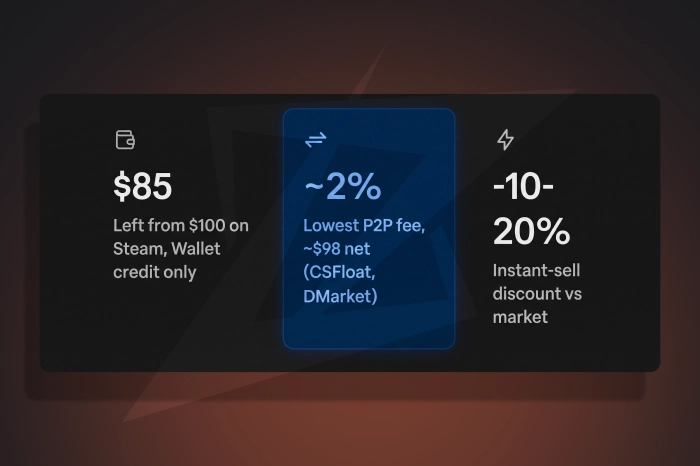
| What’s left from a $100.00 skin on Steam | ~$85.00 — and only as Steam Wallet credit, not cash |
| Lowest P2P seller commissions in 2026 | ~2% (CSFloat, DMarket) → ~$98.00 from a $100.00 skin |
| Typical instant-sell pricing | 10–20% below the platform’s market price |
| Time to real money after Trade Protection | ~8 days (7-day hold + processing) on third-party platforms |
The main takeaway: your cashout channel matters more than your skin’s price. Between selling on Steam for wallet credit and selling the same skin on a low-fee P2P platform for real money, the difference in net payout reaches ~13 percentage points — and the gap between “fast” and “profitable” now includes calendar days of waiting.
Methodology. This index draws on publicly available data: official Steam documentation, aggregators SteamAnalyst and CSMarketCap, trackers PriceEmpire and CSGOStocks, plus aggregated anonymized data from trading platforms (June–July 2026). All figures are approximate and current as of writing — the market moves fast, so treat every number as a snapshot rather than a fixed rate.
B — Platform Fee Comparison
Three selling channels, three different economies. Here’s what a CS2 skin selling fee comparison 2026 looks like on a $100.00 skin (all figures approximate, June–July 2026):
| Channel | Seller commission | Real payout from $100.00 | Speed to money |
|---|---|---|---|
| Steam Community Market | ~15% (5% Steam + 10% game) | ~$85.00 — Steam Wallet only | Sale: minutes to days. Wallet credit is instant, but nothing leaves Steam |
| P2P: CSFloat | ~2% (0.5% on high-value lots) | ~$98.00 | Buyer wait + ~8 days Trade Protection before payout |
| P2P: DMarket | ~2% (liquid items; up to 10% illiquid) | ~$98.00 | Same, plus 0–2% withdrawal depending on method |
| P2P: BUFF163 | ~2.5% | ~$97.50 | Same; oriented toward the Chinese market |
| P2P: Skinport | ~6–12% (lower on high-value lots) | ~$88.00–94.00 | Consignment sale, 0% bank withdrawal |
| Instant-sell bots (market average) | price set 10–20% below market | ~$80.00–90.00 equivalent | Sells instantly; cash withdrawal follows platform rules |
The defining shift of 2026 isn’t commissions — it’s time. On July 16, 2025, Valve switched on Trade Protection: every CS2 item received in a trade carries a 7-day “yellow shield” during which the sender can reverse the deal. Platforms had to adapt: money from a sold skin goes into escrow and pays out roughly 8 days later, once the reversal window closes. Some platforms offer instant payouts within limits, absorbing the reversal risk themselves — but that’s the exception, not the rule.
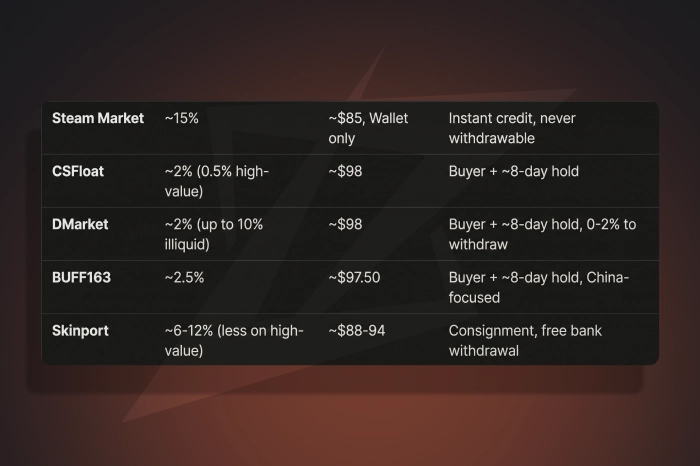
Which creates the table’s central paradox: Steam credits “money” instantly, but it’s permanently locked inside the ecosystem. P2P platforms pay real money and charge 5–7 times less commission, yet a week-plus sits between the sale and your bank account. The net payout CS2 skin after fees difference between the worst and best route on a $100.00 skin runs about $13.00 — and it scales with your inventory’s value.
One trap the landing pages stay quiet about: instant-sell percentages are almost always calculated from the platform’s internal cash valuation, not from the Steam price. “83% payout” on the banner can mean noticeably less than 83% of the number you see on the Steam Market — compare final dollar amounts, not percentages.
C — Payout Methods
The platform’s commission is only the first layer. The second slice of reality is CS2 skin payout methods: how you actually collect your money, and how much that method eats on top. Here’s the public picture across the main routes (June–July 2026):
| Method | Extra withdrawal fee | Speed | Regional availability |
|---|---|---|---|
| Steam Wallet | 0% — but withdrawal doesn’t exist | Instant | Everywhere Steam operates |
| PayPal | Varies by platform; not universally available | Minutes to 1–2 days | Limited country list; some platforms dropped it entirely |
| Card (Visa/Mastercard) | ~1–3% + a fixed fee in many cases | 1–7 business days | Wide; usually requires KYC |
| Bank / SEPA | 0% (Skinport, SkinBaron) up to ~2% | 1–7 business days; first withdrawal takes longer | European Union — the best-case scenario |
| Crypto: USDT / ETH | ~0–2% or a small fixed fee (some platforms charge ~$0.10) | Minutes — the fastest route to real money | Global; minimum withdrawal thresholds apply |
| Crypto: BTC | ~1.5–2% + network fee | Minutes to hours | Global; often higher minimum threshold |
Here’s what matters. Steam Wallet is the only method with an honest zero commission — but it’s a one-way zero: funds land instantly and stay inside Steam forever, and Valve’s official documentation states plainly that wallet funds can’t be transferred. Every other method pays real money while adding its own friction layer.
Crypto is the outright speed champion in 2026: on some platforms a USDT withdrawal takes 1–3 minutes after the deal closes, which is exactly why the query sell CS2 skins for crypto keeps climbing. The flip side is minimum thresholds — platforms often require $30.00 to $100.00 on crypto methods, which cuts off small amounts.
PayPal tells a different story: some platforms support it only in a limited country list, others removed it entirely, and CS2 skin cashout PayPal fees vary from platform to platform — no universal rate exists. Before picking a route, look at the final amount in the withdrawal preview rather than the percentage on the landing page.
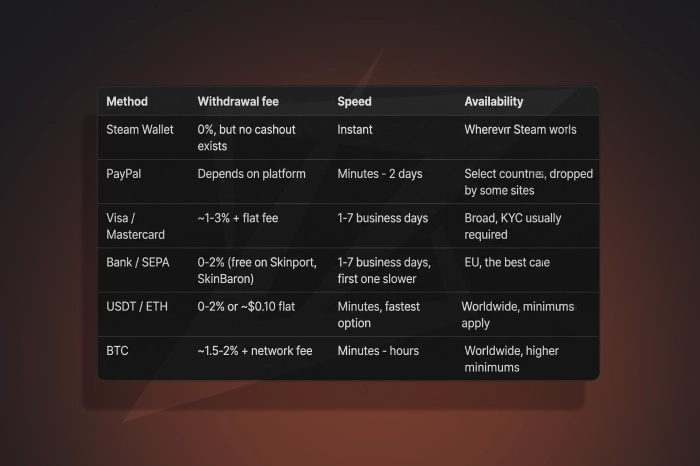
And here’s the general principle, confirmed by aggregated comparisons like the platform overview at SteamAnalyst: CS2 skin withdrawal speed and payout size almost always work against each other. Instant routes (crypto, e-wallets) either charge a percentage or impose thresholds; free ones (SEPA on select platforms) make you wait banking days; and the “zero-fee” Steam Wallet never lets money out at all. The “fast — cheap — cash” triangle still closes on only two corners in 2026.
The hidden layer: not commission, but failed transactions
There’s a metric nobody includes in platform comparisons — the share of withdrawals users start but never complete. According to Skin.Place data, method distribution breaks down like this: Cardpay accounts for 53.28% of all withdrawals, crypto for 38.10%, Zen for 5.05%, Convrt for 3.50%, and wallet codes for 0.07%. Now the second, far more interesting slice: the share of failed transactions within each method. For crypto it’s just 2%. For Cardpay — 28%. For Zen — 32%. For Convrt — 38%.
Read those numbers together and an unexpected conclusion emerges. More than half of users choose cards — the familiar option — yet nearly one in three card withdrawal attempts never completes: the bank declines it, anti-fraud triggers, verification fails, the session expires. Crypto gets chosen less often, but it barely ever fails: 98 successful attempts out of 100.
This isn’t about commission percentages — it’s about whether the money arrives at all. If predictability matters to you, stablecoins beat cards not so much on cost as on the probability of a completed withdrawal.
D — Skin Categories: Does the Real Payout Percentage Change by Price Tier?
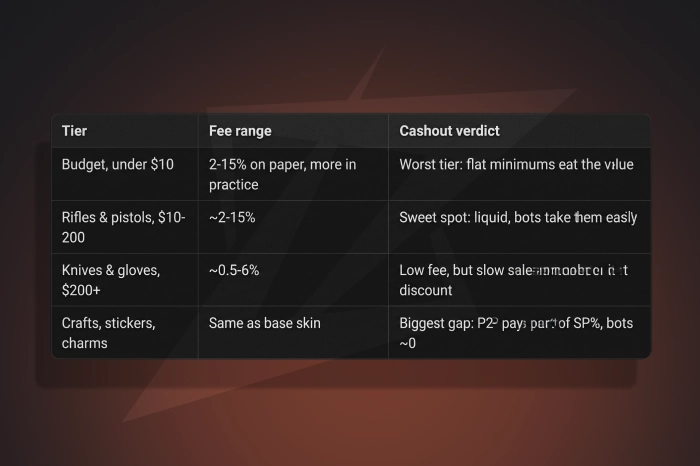
Short answer: yes, and not linearly. The commission percentage drops as item price rises, but liquidity and sale speed move in the opposite direction. Here’s the picture across four tiers (public data, June–July 2026):
| Category | Typical commission | Payout reality |
|---|---|---|
| Budget (<$10.00) | Formally the same 2–15%, effectively more | Worst tier for cashing out: fixed minimums eat small amounts |
| Rifles and pistols ($10.00–200.00) | ~2–15% standard | The healthiest zone: maximum liquidity, bots accept them readily |
| Knives and gloves ($200.00+) | Lowest rates: ~0.5–6% on high-value | Lower commission, but slower sales and a bigger instant-sell discount |
| Stickered crafts, stickers, charms | Same as the base skin | Widest gap: P2P pays a share of SP%, bots pay almost nothing |
The budget tier suffers most — and not because of percentages, but because of fixed amounts. On Steam, each of the two commissions has a $0.01 minimum, so an item priced at $0.03 nets the seller $0.01 — an effective rate of 66%. Third-party platforms cut from below differently: some won’t accept items under ~$0.50 at all, and minimum withdrawal thresholds of $30.00–100.00 on crypto methods lock small balances away from real money. Add fixed withdrawal fees, and selling a handful of cheap skins becomes an exercise with a near-zero result.
The mid tier ($10.00–200.00) is peak efficiency. Popular rifles and pistols are liquid, buyers appear quickly, bots accept them without restrictions, and standard commissions work as advertised. Comparing CS2 skin fees across tiers, this is where nominal and real percentages match most often.
Knives and gloves ($200.00+) look best on paper: high-value rates drop to ~0.5% (CSFloat) and ~6% (Skinport). But an expensive item hunts for its buyer longer, and instant channels build a steeper discount into the price — trader guides note directly that bot pricing ratios are worse on expensive items. This is where the P2P marketplace vs instant sell CS2 choice bites hardest: patience converts into tens, sometimes hundreds of dollars.
Stickers, crafts, and charms are their own economy. On the P2P market, an applied sticker transfers only a fraction of its value into the skin’s price (Sticker Percentage) — estimates vary widely: roughly 1–5% for typical stickers, and anywhere from 5% to 50% for legendary Katowice 2014 pieces, depending on the skin and the buyer. Bots and instant-sell channels, meanwhile, usually value stickers at zero — if a platform doesn’t explicitly state a sticker value, assume you’re gifting those stickers to the bot. The rule is simple: crafts sell to people, not machines.
Internal statistics confirm this hierarchy in numbers. According to Skin.Place data, platform sales break down as follows: weapon skins — 62.6%, cases — 14.1%, stickers — 13.0%, knives — 5.6%, gloves — 2.7%, agents — 2.1%. Note two things: cases as a category outrank knives and gloves combined (14.1% versus 8.3%) — cheap liquid goods turn over faster than expensive ones; and stickers, the very items bots “can’t see,” still account for a seventh of all sales — a market for them exists, it just lives on P2P rather than in instant channels.
E — Regional Breakdown: US, Poland, Brazil
Disclaimer: this section is not tax or legal advice. The tax treatment of selling virtual items depends on your country and your situation — consult a local specialist.
Geography is the underrated layer of cashout economics. The same skin, sold at the same price, becomes different amounts in hand depending on which withdrawal methods your country offers and what they cost. This section combines public data with aggregated platform statistics by region.
United States. The widest set of classic methods: PayPal, bank transfers, cards — plus near-universal KYC requirements on fiat withdrawals. A market quirk: some platforms operating under European regulation are built around SEPA, so American users more often end up with cards, PayPal, or crypto. Speed ranges from minutes (e-wallets) to a week (bank).
Poland. One of Europe’s most active skin markets, and it enjoys a double advantage. First, BLIK: a local instant payment system the industry supports alongside global methods. Second, SEPA: on select platforms, withdrawing to a European bank costs 0%, making the Polish route one of the cheapest in the world. A telling public fact: according to the Pricempire catalog, 45% of Skin.Place’s audience consists of Polish users — local methods explain that better than any advertising.
That logic now has internal numbers behind it: according to Skin.Place data, BLIK accounts for 77.35% of all withdrawals by Polish users. Three out of four Polish cashouts run through the local method — clear proof that the “last mile” decides more than any global commission percentage.
Brazil. A textbook case of a market where banking friction pushes users toward alternatives. Global fiat methods work slower and cost more here, so Brazilian sellers rely on two routes: the local instant payment system Pix (support for it became standard across major platforms) and stablecoins — USDT on TRC20, which arrives in seconds with a fee under $1.00 and bypasses banking infrastructure entirely.
Internal figures confirm this almost word for word: according to Skin.Place data, Pix accounts for 75.39% of withdrawals among Brazilian users, with crypto at 18.2%. Together, the two “workaround” routes take over 93% of the market, leaving classic banking methods less than a tenth — a rare case where local infrastructure has almost entirely displaced the global kind.
The overall regional conclusion: in any CS2 marketplace comparison for your country, look past the global commission percentage and price the last mile — the method that actually delivers money to you. Europeans with SEPA live cheapest on P2P platforms with free bank withdrawals; Brazilians move faster and cheaper through Pix or USDT; Americans should factor KYC and card fees into their math upfront.
A reminder: everything above is an overview of market practices, not tax advice. Rules for declaring income from virtual item sales differ across the US, Poland, and Brazil — consult a local specialist.
F — Takeaways: Which Route to Choose
The whole index boils down to one question: what matters more to you — speed, amount, or simplicity? There’s no universal answer, but there are three honest routes.
If speed matters. Instant-sell plus crypto withdrawal is the shortest path from inventory to real money: the sale takes seconds, and USDT arrives minutes after the hold expires. The price of that speed is a 10–20% discount off market value plus minimum withdrawal thresholds. It’s the fastest CS2 skin cashout available in 2026, and also the most expensive in lost percentage points.
If the amount matters. A low-commission P2P marketplace (~2%) paired with a cheap withdrawal method (SEPA in Europe, crypto with a small fixed fee) maximizes what lands in your hands: ~$96.00–98.00 for every $100.00 of market price. The cost is time: waiting for a buyer plus the ~8-day Trade Protection window. This is the combination most reviews actually mean when they rank the best CS2 cashout sites 2026 — the winners aren’t brands, they’re low platform commissions paired with a cheap last mile.
If you need the money inside Steam. The Community Market stays the simplest route: instant credit, zero scam risk, no KYC. Just remember that Steam Community Market fees of ~15% buy you credit that will never leave Valve’s ecosystem. Perfect for your next case; useless for paying bills.
The full cheat sheet:
| Priority | Route | Real payout from $100.00 | Time to money |
|---|---|---|---|
| Speed | Instant-sell → crypto | ~$80.00–90.00 | Minutes to hours after the hold |
| Amount | P2P ~2% → SEPA/crypto | ~$96.00–98.00 | Days to weeks |
| Simplicity | Steam Market → Wallet | ~$85.00 (non-withdrawable) | Instant |
| Small amounts | Accumulate to threshold, sell in batches | Depends on method | — |
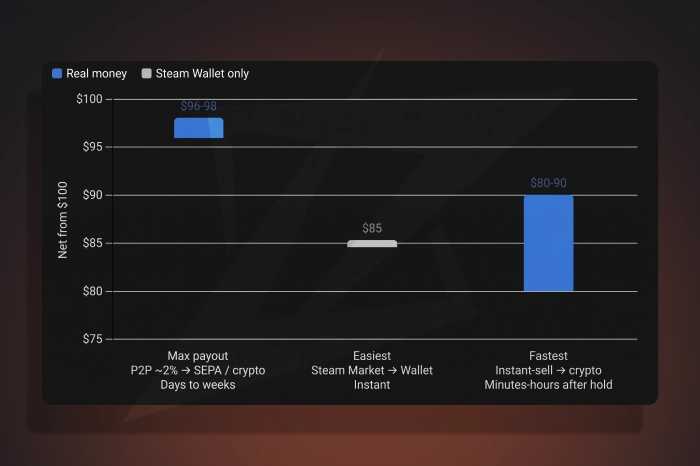
And three rules that hold in every scenario. First: how to cash out CS2 inventory always involves two commission layers — the platform’s and the withdrawal method’s; calculate both before the sale, not after. Second: compare final dollar amounts in the withdrawal preview, not percentages on landing pages — CS2 skin fees love hiding in rounding, thresholds, and internal cash valuations. Third: different tasks call for different platforms, and a solid CS2 marketplace comparison once a quarter saves more than chasing one extra percentage point. And when picking among the best CS2 cashout sites 2026, start by checking current rates and CS2 skin payout methods for your region — up-to-date withdrawal rates are always visible on Skin.Place.
FAQ
How much does Steam Community Market actually take from a skin sale?
The full commission is around 15%: a 5% Steam fee plus a 10% CS2 game fee. On a skin a buyer pays $100.00 for, the seller receives roughly $85.00 — and only as Steam Wallet credit with no withdrawal option. On cheap items the effective rate runs higher because of the $0.01 + $0.01 minimum fees.
How does cashout friction affect my net payout on a $100 skin?
Friction stacks in two layers: the platform's selling commission and the payout method's fee. Depending on the route, a nominal $100.00 leaves you with anywhere from ~$80.00 (instant-sell plus a paid withdrawal) to ~$98.00 (low-fee P2P with free SEPA). The spread between worst and best runs about $13.00–18.00.
Are there hidden fees beyond the platform commission?
Yes, several: the withdrawal method fee, minimum thresholds ($30.00–100.00 on crypto methods at some platforms), blockchain network fees, and currency conversion. Instant-sell hides its own trap: the payout percentage is calculated from the platform's internal cash valuation, not the Steam price. Always verify the final amount in the withdrawal preview.
What is the difference in real payout between instant-sell and P2P marketplace?
Instant-sell pays immediately but 10–20% below market price. A P2P platform charges only ~2–12% commission but requires waiting for a buyer and sitting through the ~8-day Trade Protection window. On a $100.00 skin the net difference reaches $8.00–18.00 in P2P's favor — essentially, that's the price of your patience.
Which payout method has the lowest total fees — PayPal, bank transfer, or crypto?
There's no universal winner — region decides everything. In Europe, SEPA is cheapest: several platforms charge 0% for bank withdrawals. Globally, the most predictable option is stablecoins like USDT with 0–2% fees and a small network charge, while PayPal fees vary by platform and the method isn't available everywhere.
Does the price of a skin affect the real payout percentage?
Yes, and not linearly. Cheap items suffer from fixed minimums: fees, withdrawal thresholds, and minimum acceptance prices consume a noticeable share. Expensive knives and gloves get preferential rates (down to ~0.5–6% on high-value items) but sell slower, and instant channels build a steeper discount into them.
Do stickers affect the cashout value when selling to a bot?
Usually not: bots and instant-sell platforms typically value applied stickers at zero unless they explicitly state otherwise. Part of a sticker's value (Sticker Percentage) transfers into the price only when selling to a live buyer on P2P. The rule is simple: crafts sell to people, not machines.
What is Steam Trade Protection and how does it affect cashout speed in 2026?
It's a Valve mechanic launched on July 16, 2025: every CS2 item received in a trade carries a 7-day protected status during which the sender can reverse the deal. Platforms responded with escrow — money from a sold skin pays out roughly 8 days later, once the reversal window closes. Some platforms offer instant payouts within limits, absorbing the risk themselves.
Does my country affect the final amount I receive?
Yes, through the "last mile" — the range and cost of available withdrawal methods. A European with free SEPA, a Pole with BLIK, and a Brazilian with Pix or USDT all end up with different final amounts from an identical sale. Add regional KYC requirements and differing tax treatment, and geography becomes a full layer of cashout economics.
How long does a full cashout take from trade to money in wallet?
On Steam it's instant, but the money stays in your Wallet forever. On third-party platforms the path combines the sale (seconds on instant-sell, days or weeks on P2P), ~8 days of Trade Protection, and the withdrawal itself (minutes on crypto, up to 7 business days on bank transfers). A realistic full cycle in 2026 runs from ~8 days at best to over two weeks.

Subscribe
0 Comments