Karambit Blue Gem Guide: Everything About Case-Hardened Karambit Patterns
11
min
0
0
Picture a knife someone offered a million and a half dollars for — and the owner turned it down because the sum felt too low to him. Sounds made up, but it’s the real story of the Karambit Blue Gem numbered 387. The Karambit is already the most coveted knife in CS2, and when the legendary Case Hardened finish lands on it with a rare blue pattern, it transforms into a true digital Grail that collectors all over the world hunt for.
The whole catch is that Case Hardened paints its pattern at random, and only a handful of pattern seed values deliver enough clean blue to turn a knife into a Blue Gem. In this guide, we’ll break down how patterns work, why a Case Hardened Karambit can sometimes cost as much as an apartment, what’s so magical about seed #387, and how to avoid getting scammed when you decide to buy your own.
What Is a Karambit Blue Gem?
Before diving into patterns and prices, let’s get the basics down — what actually makes a knife a “blue gem” and why there’s so much noise around it.
Understanding the Case Hardened Finish
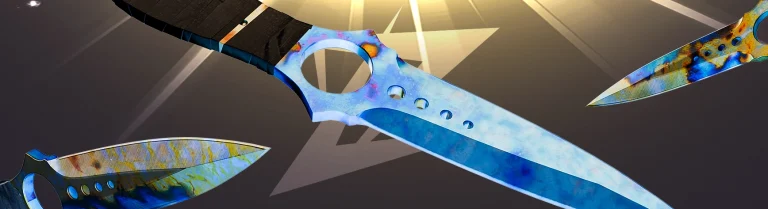
Case Hardened is a finish that mimics the chemical metal-hardening process. Instead of an even, single color, the blade gets covered in blotches of blue, purple, and gold that blend into one another. Striking? Absolutely. But the key feature is that those blotches are generated at random.
The placement of the colors is handled by the pattern seed — a number the game assigns to each copy the moment it’s created. That’s exactly why no two Case Hardened Karambit are alike: one blade might be almost entirely gold, another drenched in deep blue, and a third a motley mix of everything at once. It makes each knife unique, like a fingerprint, and at the same time lays the groundwork for all the collector madness around blue patterns.
What Makes a Karambit a Blue Gem?
So, what is a Blue Gem? Simply put — it’s a Case Hardened Karambit where blue dominates the play side, meaning the side of the blade you see during gameplay. The more clean blue and the fewer the gold specks on the visible side, the more valuable the knife.
And here’s the key point a lot of people miss: it’s the play side that matters. A knife can have a stunning blue side, but if it’s hidden on the back side, which is barely visible in the animations, the value will be far more modest. That’s why a real Blue Gem Karambit isn’t just “lots of blue somewhere on the blade” — it’s lots of blue exactly where it catches the eye. A regular Case Hardened with a gold or mixed play side costs hundreds of dollars, while a top blue pattern runs into the tens and hundreds of thousands. The gap is enormous, and it all comes down to where the color sits.
Why Blue Gem Karambits Are So Rare?
The rarity here isn’t a marketing angle — it’s pure math. The pattern seed runs from 1 to 1000, and only a small fraction of those deliver that coveted blue on the play side. The truly top patterns number a literal dozen, and the absolute king is just one.
Add to that the insane demand. The Karambit is an iconic knife, Case Hardened is an iconic finish, and their combination in a blue version has become something like the Rolex of the CS2 world. There are far more collectors who want a knife like this than there are knives, and that gulf between demand and supply only widens every year.
When an item physically can’t be re-released, and the number of people chasing it keeps growing, the price moves in one direction — up. That’s exactly why a top-level Blue Gem Case Hardened Karambit today is more of an investment asset than just a skin.
How do Karambit Blue Gem Patterns Work?
Now let’s dig deeper — how the pattern system actually works, and what criteria collectors use to tell a top seed from a mediocre one.
What Are Pattern Seeds in CS2?
Every skin with a random pattern — and Case Hardened is exactly that — gets a pattern index, also known as a pattern seed, when it’s created. It’s a whole number in the 1 to 1000 range that works as an instruction set for the game: where to place the blue blotches, where the gold ones go, what shape they take, and how saturated they are.
It’s important to understand that the number itself doesn’t “mean” anything — it’s not a rating or a score. Each number simply corresponds to its own unique design. The community has been cataloging these designs for years, sifting through the thousand variants to find the ones that deliver the most beautiful blue. That’s how the lists of “best” seeds were born, where a number like #387 or #888 is instantly recognized by collectors around the world.
Play Side vs Back Side Blue Coverage
This is the single most important principle in evaluating any Karambit Blue Gem pattern, and it’s exactly where newcomers trip up most often. A knife has two sides: the play side — the one turned toward the player in most animations — and the back side, the reverse, which is barely visible.
Collectors evaluate the play side first and foremost. A knife with gorgeous blue on the front side will cost several times more than an otherwise identical copy by blue volume, where all that blue is hidden on the back. So when you see a “blue karambit” for sale — always look at which side is actually blue. A good example of the evaluation logic: two knives can have the same overall percentage of blue, but the one with the play side drenched in blue is easily worth ten times more. The back side adds value only as a nice bonus, once the front side is already flawless.
Blue Gem Tier Classifications
To keep from getting lost in the thousand patterns, the community split the best of them into rough tiers — from the bluest down to the barely blue:
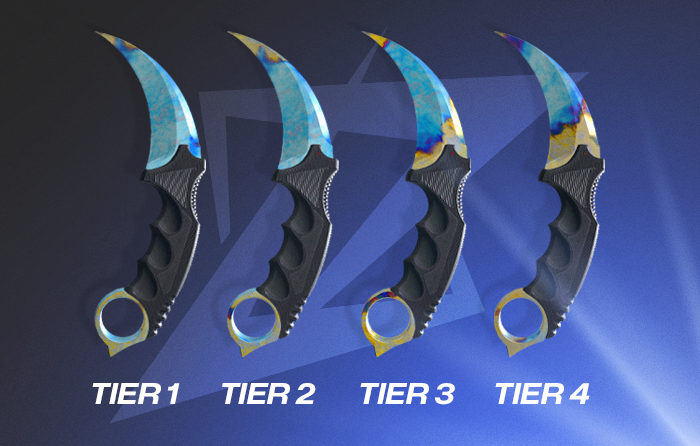
- Tier 1 — a nearly fully blue play side, 90–100% coverage. Almost no gold. These are the most expensive and most coveted seeds.
- Tier 2 — strong blue, roughly 70–90% of the play side, with small gold accents. A great look for a noticeably more reasonable price.
- Tier 3 — a balanced option, 50–70% blue. Gold is clearly visible now, but blue still dominates.
- Tier 4 — entry level, under 50% blue. More “blue accents” on a gold background than a true blue blade.
And a fair warning up front: this system is community-based, not official from Valve. Different sources can classify the same seed differently — what’s Tier 2 in one guide is sometimes Tier 3 in another. So from here on, we lean on one of the community’s most authoritative lists, but treat the tiers as a guideline, not gospel.
All Karambit Blue Gem Pattern Tier List
Here’s a summary table that shows the classification logic. It’s built on one of the most authoritative community guides (from korenevskiy and Krieke) — featuring the best-known seeds of each level with approximate blue coverage and demand level:
| Pattern Number | Tier Ranking | Blue Coverage | Collector Demand |
|---|---|---|---|
| 387 | #1 (God Tier) | ~100% play side | Extreme |
| 73, 269, 442, 463, 510 | Tier 1 | 90-100% | Very high |
| 776, 809, 853, 888, 905 | Tier 1 | 90-100% | Very high |
| 321, 507, 661, 828, 955 | Tier 2 | 70-90% | High |
| 74, 130, 377, 494, 727 | Tier 2 | 70-90% | High |
| 25, 306, 310, 575, 798 | Tier 3 | 50-70% | Moderate |
| 92, 341, 429, 631, 989 | Tier 3 | 50-70% | Moderate |
| 38, 122, 398, 595, 961 | Tier 4 | <50% | Low |
| 405, 488, 639, 822, 974 | Tier 4 | <50% | Low |
Since the full list of karambit blue gem patterns is much longer, here are all the seeds for each tier:
#1 (God Tier): 387.
Tier 1 (10 patterns): 73, 269, 442, 463, 510, 776, 809, 853, 888, 905.
Tier 2 (35 patterns): 34, 74, 82, 130, 150, 152, 236, 256, 262, 303, 321, 322, 346, 375, 377, 406, 413, 453, 494, 503, 507, 509, 541, 550, 601, 643, 661, 698, 727, 770, 811, 823, 828, 914, 955.
Tier 3 (54 patterns): 9, 11, 20, 25, 30, 57, 59, 92, 112, 138, 139, 154, 179, 182, 216, 246, 265, 273, 282, 306, 310, 323, 330, 341, 366, 400, 426, 429, 450, 490, 499, 515, 530, 553, 575, 580, 631, 655, 664, 670, 711, 713, 721, 798, 838, 841, 844, 849, 852, 856, 891, 917, 965, 989.
Tier 4 (54 patterns): 38, 85, 106, 109, 122, 128, 146, 194, 244, 254, 259, 334, 335, 371, 381, 398, 405, 407, 420, 430, 455, 472, 485, 487, 488, 522, 539, 555, 563, 571, 595, 615, 616, 637, 638, 639, 644, 676, 694, 728, 766, 782, 796, 803, 810, 814, 822, 916, 919, 935, 942, 961, 970, 974.
Keep in mind: other resources may list slightly different seeds — for instance, adding ones like #902 or #632 that aren’t in this guide, or shifting patterns between neighboring tiers. That’s normal for community classification, so before any expensive purchase, always cross-check the specific seed across several sources.
Karambit Blue Gem Pattern 387: The Most Valuable Blue Gem Seed
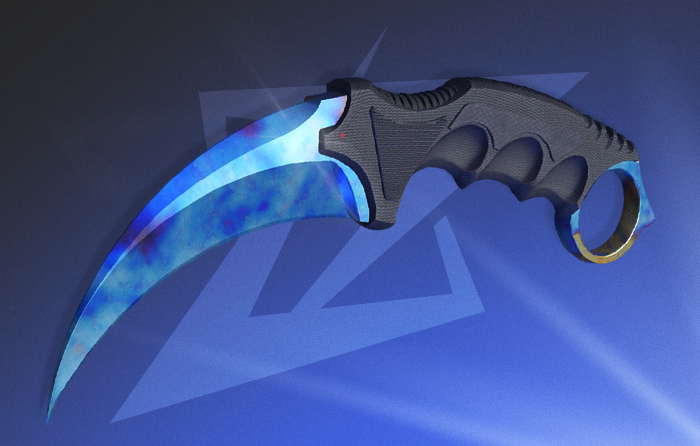
If there’s an absolute king in the world of Case Hardened, it’s seed #387 — the face of the entire Blue Gem phenomenon and the benchmark every other pattern is measured against.
Why this one? #387 is the only pattern with a play side that’s almost 100% drenched in blue, with practically no gold or purple specks. It’s that “perfect storm” of RNG that may never come around again. The rest of the top seeds have at least a little gold, so #387 sits in its own “God Tier” — separate even from the rest of Tier 1.
And here it’s important to bust the main myth, because the internet is full of confusion around the Blue Gem Karambit 387 cost. In September 2021, an anonymous buyer, working through the middleman ohnepixel, offered the owner around €1.2 million in Bitcoin (roughly 22 BTC, about $1.5 million at the time).
The reply went down in CS2 history: “Not interested, 1.2 is low.” In other words, the knife was never sold — there’s never been a single confirmed public deal on #387, and every figure around it is an estimate based on rejected offers. There were also rumors of a later offer closer to $2 million, but it remained unconfirmed.
How rare is Karambit Blue Gem pattern 387? Only around nine of these knives exist across all wear levels, and just one in Factory New (with a record-low float of 0.048). The odds of unboxing it in FN from a case are roughly 1 in 833 million. On Case Hardened, scratches don’t appear even at a high float, but near-maximum wear covers the blade in a dark patina that mutes the blue — which is exactly why a clean FN makes this particular copy priceless.
Karambit Blue Gem Price Guide
Okay, now for the heavy topic. Prices on a Karambit Blue Gem CS2 are a universe of their own, where the gap between neighboring tiers is measured not in percentages but in multiples. Let’s break down what shapes the Karambit Blue Gem price and what the knives at each level actually cost.
What Determines a Karambit Blue Gem Price?
We’ve already touched on a few times what affects the price, but let’s break it down in more detail so you can build a clear picture in your head.
Five factors shape the final price tag:
- Pattern seed — the main one. The pattern tier sets the base order of magnitude for the price, and nothing else outweighs it.
- Wear condition — the level of wear. Factory New costs several times more than the beat-up variants.
- Float value — even within the same condition, a lower float bumps the price up by 20–40%, since it preserves the purity of the blue.
- StatTrak™ — the kill counter adds rarity; a StatTrak FN Blue Gem is one of the most expensive setups possible.
- Market demand — interest in a specific named seed can drive the price up regardless of everything else.
Karambit Blue Gem Price by Tier
Here are the approximate ranges as of 2026. This isn’t a fixed price list, but more of a market map — real deals depend on the float, the screenshots, and how willing a particular collector is to pay.
| Tier | Typical Price Range | Demand Level |
|---|---|---|
| Regular Case Hardened (not Blue Gem) | $600 – $1,700 | Baseline |
| Tier 4 | $1,000 – $6,000 | Moderate |
| Tier 3 | $2,000 – $10,000 | High |
| Tier 2 | $10,000 – $50,000 | Very high |
| Tier 1 | $30,000 – $100,000+ | Extreme |
| #387 (God Tier, FN) | $1.5 – $2 Million | Unique |
To put the scale in perspective: a documented sale of a Well-Worn #387 in June 2023 came in at around $120,000 — and that wasn’t even a Factory New copy.
How to Buy and Authenticate a Karambit Blue Gem?
Buying a Karambit Blue Gem isn’t the same as buying a regular skin. There are thousands, sometimes tens of thousands, of dollars on the line here, so the verification matters just as much as the purchase itself. Here’s a step-by-step breakdown.
How to Check Pattern Seeds?
The first thing to do with any listing is to look at its pattern seed. Every listing has an inspect link or an “Inspect in Game” button. Copy that link and paste it into whatever service you find convenient — it’ll instantly show you the exact pattern index and float without launching the game. Skip this step, and you’re buying a pig in a poke, so never leave it out.
Identifying Real Blue Gem Patterns
Knowing the number isn’t enough — you need to understand what it means. Cross-check the seed against the tier table (the one we laid out above) and be sure to look at real screenshots of the play side specifically. This is where the main newcomer trap hides: a seller might show you a stunning blue back side while the front side is half gold. Remember — it’s the blue on the visible side that determines value. A real Karambit Blue Gem Pattern has plenty of clean blue exactly where you see it during gameplay.
Trusted CS2 Skin Marketplaces
Buy expensive knives only on platforms with pattern verification and buyer protection, where you can see the float, the seed, and real photos before paying. A reliable marketplace takes most of the risk off the table — you see exactly what you’re buying. It’s easy to buy (CS2) CS:GO Skins with transparent verification, and if you decide to part with your knife, it’s just as safe to sell CS2 (CS:GO) skins without the risk of running into a scammer in your DMs.
Red Flags and Common Scams
The world of expensive skins is crawling with scammers, so keep these red flags in mind:
- A price noticeably below market — almost always a sign of a con.
- Fake middlemen in Discord who “guarantee” the safety of the deal.
- Phishing links to fake “verification” or trade sites.
- Pressure and rush — a real seller never forces you to decide in seconds.
- DMs from unknown “buyers” with attractive offers.
Questions to Ask Before Buying a Blue Gem
Before you wire any money, ask the seller (and yourself) a few questions:
- What’s the exact pattern seed, and is it confirmed through an inspect link.
- What’s the float value, and does it match the stated condition.
- Are there fresh screenshots of the play side straight from the game.
- Why the price is what it is, and whether it matches the pattern tier.
- Whether the deal goes through a secure platform or escrow.
Karambit Blue Gem vs Other Blue Gem Skins
The Karambit isn’t the only knife with blue patterns, but it’s the one that became the benchmark. Why? First of all, the blade shape: the karambit’s curved blade shows a large play side area in the inspect and holding animations, so the blue here literally jumps out at you. Add the iconic status of the model itself, and you get the most expensive Blue Gem market in the game.
For comparison, other Case Hardened items play in lower price leagues. The AK-47 Case Hardened has a legend of its own — pattern #661, the “Blue Top,” which is prized very highly, but even it rarely reaches the karambit’s six-figure sums.
Budget-friendlier knives like the Gut Knife or Navaja Knife have their own Tier 1 seeds that look striking for just a few hundred dollars — a great option for anyone who wants a blue blade without the sky-high price tag. And the Hydra Gloves Case Hardened carry that same blue-pattern system over to gloves, though without the dramatic Tier 1 that knives have.
The takeaway is simple: if you’re after maximum prestige and an investment, the karambit is in a class of its own. But if you want blue on a budget, it’s worth looking wider.
We covered exactly how blue patterns work across different items in detail in a separate piece on CS2 (CS:GO) blue gem patterns, and for anyone still choosing a knife type, our rundown of CS2 (CS:GO) knife types will come in handy. By absolute prices, the Karambit Blue Gem stays at the top — the details are in our breakdown of the most expensive CS2 (CS:GO) knife.
Final Thoughts: Is a Karambit Blue Gem Worth It?
So, is a Karambit Blue Gem worth the money? In short — yes, but with a clear head. The truly top patterns are a literal handful: one God Tier #387, ten Tier 1 seeds, and a few more in the lower tiers. It’s exactly this rarity that keeps prices high.
#387 remains the benchmark against which everything else is measured — that same nearly 100% blue play side no other pattern replicates. But when buying your own Blue Gem, remember the main thing: always verify the pattern seed and float, look at the play side specifically, and don’t chase the hype instead of the pattern’s real quality. A top-level karambit is both a status piece and a long-term play, whose value has historically tended to climb against a fixed supply.
It’s not a quick payday, but more of a collector’s asset for those who understand what they’re paying for. And while the CS2 market can be volatile, a Case Hardened Karambit with a clean blue pattern will definitely remain one of the most coveted things in the game for a long time to come.
FAQ
What is the best Karambit Blue Gem pattern?
It's pattern #387 — the only seed with a nearly 100% blue play side. It sits in its own God Tier, separate even from the rest of Tier 1, and is considered the benchmark for all Blue Gems.
Why is Karambit Blue Gem Pattern 387 so expensive?
Because it's the perfect blend of rarity and looks: an almost fully blue blade, the only FN copy in the world, and insane collector demand. That uniqueness, which physically can't be replicated, is what drives the sky-high price.
How much is a Karambit Blue Gem worth?
Depending on the tier — from around $1,000 for Tier 4 to $100,000+ for Tier 1. The legendary #387 in Factory New is valued at $1.5–2 million.
How rare is a Case Hardened Blue Gem Karambit?
Pretty rare. Around 158 of the 1,000 possible seeds — roughly 15% of all patterns — carry enough blue to qualify as a Blue Gem. But the truly top-tier ones are a literal handful: a single God Tier #387 plus ten Tier 1 seeds, with the rest spread across the lower tiers and their lighter blue coverage.
Is every blue Case Hardened Karambit considered a Blue Gem?
No. What matters is blue on the play side specifically. A knife can have a blue back side, but if the front side is gold or mixed, it's not a real Blue Gem.
Does the float value affect Blue Gem prices?
Yes, substantially. A lower float preserves the purity and brightness of the blue, while a high one adds a darkish patina. A Factory New with a low float costs noticeably more.
Who owns the $1.5 million Karambit Blue Gem?
A private Chinese collector known in the community as 青い王 ("Blue King"), also known by the handle Newb Rage. He's the one who owns the sole FN copy of #387.
How many Blue Gem Karambits exist?
In total, around 154 patterns are classified as Blue Gems across all tiers. As for #387 specifically, only about nine exist across all wear conditions, and just one in Factory New.
Can you unbox a Blue Gem Karambit?
Technically, yes, but the odds are tiny. Unboxing any Blue Gem runs roughly 1 in 156,000, and #387 in FN specifically is around 1 in 833 million. It's simpler to buy on the market.
How can you get a Blue Gem Karambit?
There are three routes: opening cases (almost hopeless), buying on the market (the smartest), or hunting through a direct trade. Most owners simply bought their knife on a trusted platform.
How much did the famous Blue Gem Karambit sell for in CS2?
It actually never sold. In 2021, the owner turned down an offer of ~€1.2 million in Bitcoin (about $1.5 million at the time), saying "1.2 is low." Every figure around #387 is an estimate based on rejected offers, not an actual deal.

Subscribe
0 Comments